Vietnam Airport SIM Cards: Prices, Scams and the Registration Law
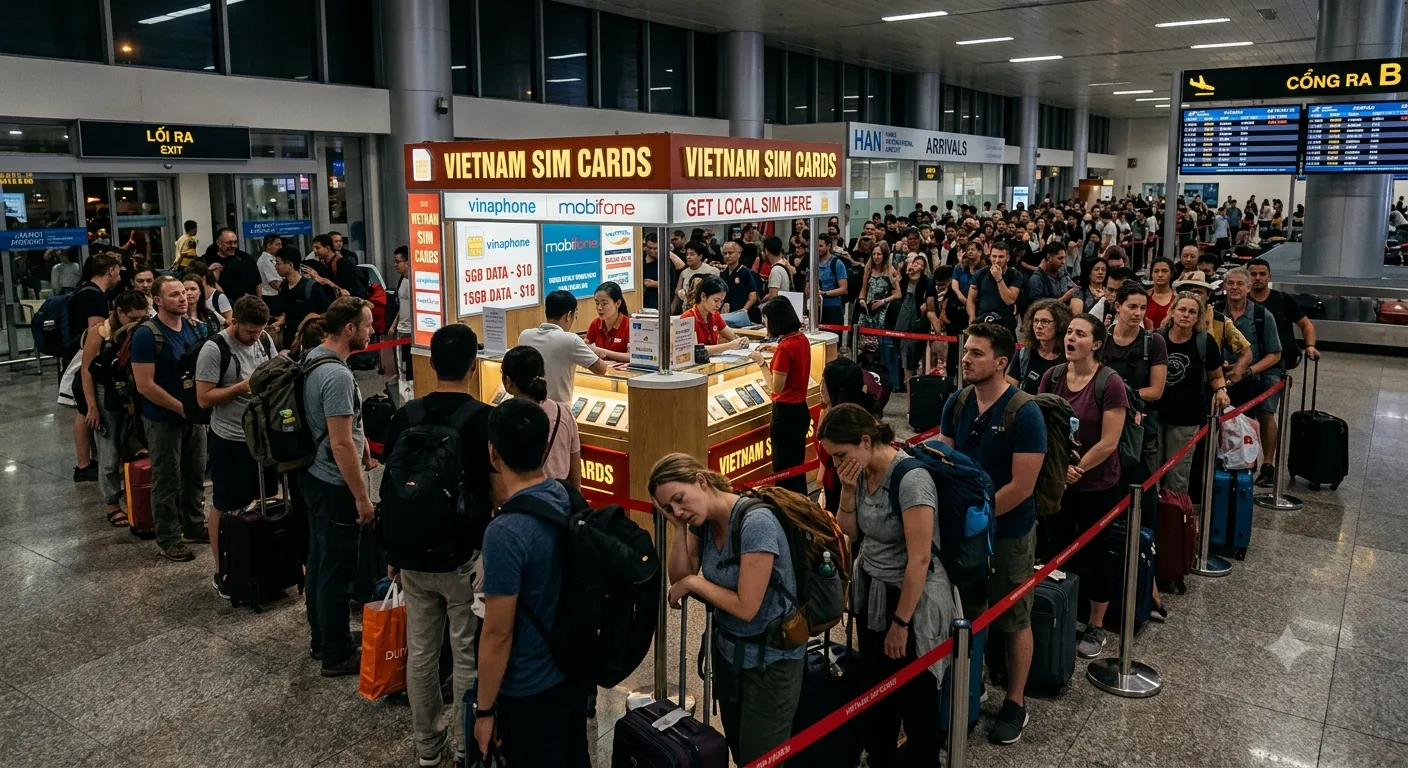
As you step off the plane, in Hanoi as in Ho Chi Minh City, SIM card counters wait for you in the arrivals hall. It’s tempting: staff install the card and confirm it works before you leave. But between inflated prices and “ghost” cards, it pays to know the traps before you reach for your wallet.
The quick answer
Buying a SIM card at the airport is convenient but rarely the best choice. Prices there are often 30–50% higher than in the city, and some “pre-activated” cards sold without a passport risk being blocked. The safest option: install an eSIM before departure and step off the plane already connected.
The real price of airport counters
At Noi Bai (Hanoi) and Tan Son Nhat (Ho Chi Minh City) airports, you’ll find all three carriers — Viettel, Vinaphone, Mobifone. The service is real: they insert the card, activate it, and check that data works. But that convenience has a cost: listed rates are typically 30–100% above the prices charged at city shops.
After a long flight, tired and in a hurry, travelers often accept the first price. That’s exactly the situation the counters count on.
What the counter actually looks like. The same queue forms at both airports every day: tired arrivals paying 200,000–400,000 VND (sometimes more) for a tourist package — typically 3–6GB/day, or a data pool spread over 7 to 30 days. The identical Viettel allowance costs closer to 60,000–180,000 VND for data alone in the city, or 150,000–300,000 VND for a full tourist bundle. It’s not really a scam — it’s rent, staffing and instant activation priced in — but it’s real money. What the counter doesn’t advertise: buying a Viettel SIM or eSIM there means passport plus a live selfie for KYC, on the spot, right after a long-haul flight. Our Vietnam eSIM runs on a genuine local Viettel profile and skips both the queue and that counter KYC step — it activates automatically the moment your phone connects on arrival, no dialing codes or manual setup. Validity in Vietnam only starts on first connection, so there’s no cost to installing it early.
The “ghost” card scam
The most common trap in Vietnam is the pre-activated or “ghost” SIM card. The idea: you’re sold a card that’s already active, without registering your passport. Convenient on the surface — but illegal, because these cards are registered under a fake identity.
The risk is real: these cards can be blocked by the carrier without warning, sometimes after a few days, leaving you with no connection mid-trip. A vendor who doesn’t ask for your passport is a red flag.
Other pitfalls reported by travelers: “unlimited” plans that slow sharply after 1GB, cards that expire earlier than promised, or a network different from the one advertised.
The SIM registration law
Since 2016, Vietnamese law requires that every SIM card be registered to an identity, passport included. When you buy at an official store or a legitimate counter, they’ll photograph your passport and sometimes you, to register it in the national database. This is normal and mandatory.
The decisive advantage of an eSIM: bought online from a reputable provider, it’s already correctly registered. You’re compliant, with no counter, and no risk of a block.
How to avoid all these traps
The simplest way to sidestep both the markup and the ghost cards:
- Buy an eSIM online before you leave. You compare prices calmly, no pressure.
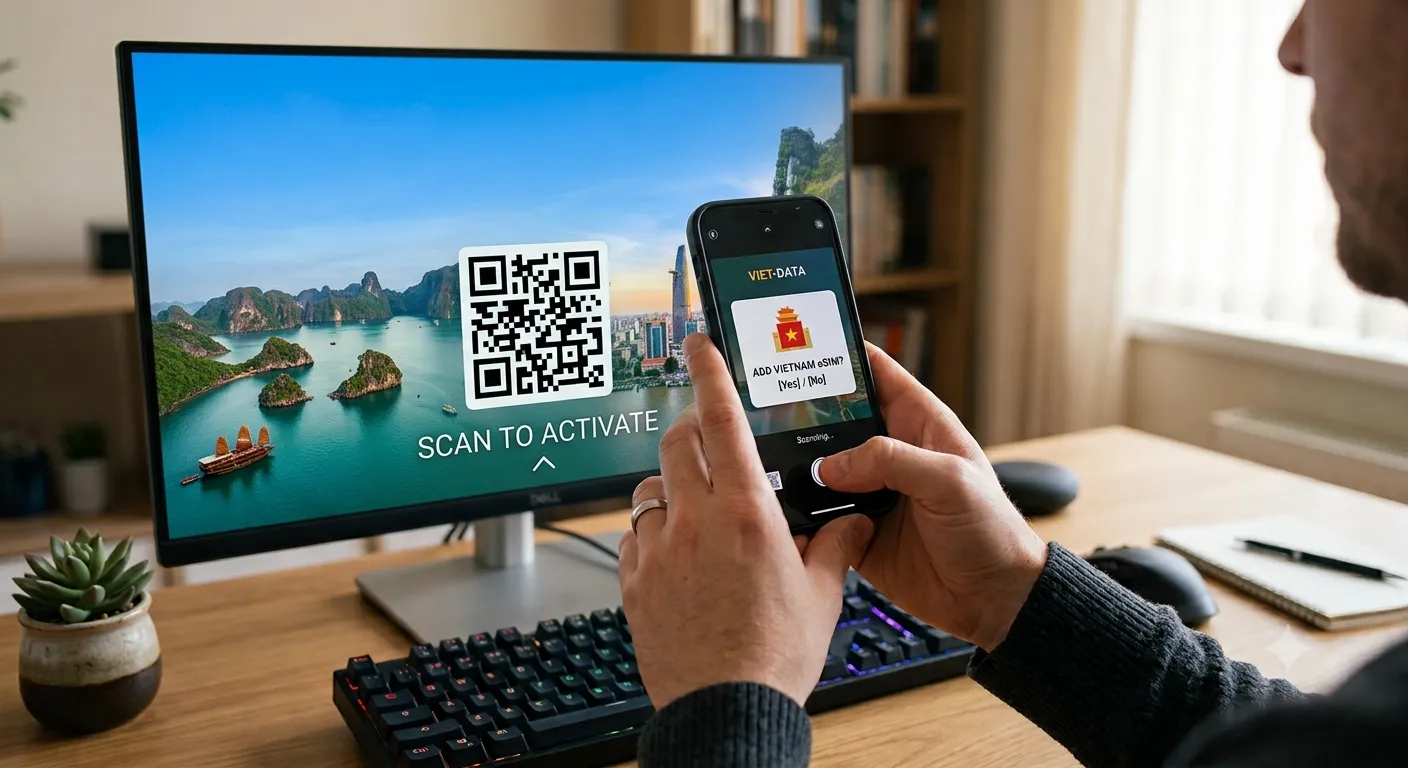
- Install it at home by scanning a QR code (a few minutes).
- Turn on data on arrival — you’re connected the moment you leave the plane, without going through the counter hall.
If your phone isn’t eSIM-compatible, buy your physical card in the city instead, at an official carrier store, passport in hand — never a “ready-made” card offered without registration.
To choose well in advance, see our network comparison and our guide on how much data to plan. For installation, it’s all explained here: installing and activating your Vietnam eSIM.
Travel with peace of mind
No queue, no passport handed to a counter, no ghost card: a local Viettel eSIM bought before departure connects you to Vietnam’s largest network the moment you land.
Choose your Vietnam eSIM at sogdiaroam.com, and find the full overview in the complete Vietnam SIM card and eSIM guide.
Flying on to Laos after Vietnam? You’ll hit the same airport-SIM traps in Vientiane or Luang Prabang — skip them with one regional Vietnam + Laos eSIM that covers both countries on a single plan, or see our dedicated Laos eSIM plans if you’d rather keep the two separate.
Frequently asked questions
Should I buy a SIM card at the airport in Vietnam? +
It's convenient but rarely optimal: airport counter prices are often 30–50% higher than in the city. Buying an eSIM online before departure avoids the queue and the markup.
What is a 'ghost' SIM card in Vietnam? +
It's a pre-activated card sold without registering your passport, under a fake identity. It works at first but risks being blocked by the carrier without warning, leaving you with no connection.
Do I have to show my passport for a SIM card in Vietnam? +
Yes. Since 2016, the law requires every SIM to be registered with a passport. A vendor who doesn't ask for it is likely offering a ghost card to avoid. An online eSIM is already registered.
Get connected for your trip
Vietnam
Vietnam · 7 days · 35GB
35GB total (5GB/day)
- 5GB high-speed data per day
- Automatic activation
- Mobile hotspot supported
Automatic. Data works the moment the eSIM connects to Viettel. Nothing to dial, nothing to switch on.
QR emailed within minutes · Stripe secure checkout · No account needed
Vietnam
Vietnam · 15 days · 75GB
75GB total (5GB/day)
- 5GB high-speed data per day
- Automatic activation
- Mobile hotspot supported
Automatic. Data works the moment the eSIM connects to Viettel. Nothing to dial, nothing to switch on.
QR emailed within minutes · Stripe secure checkout · No account needed
Vietnam
Vietnam · 30 days · 150GB
150GB total (5GB/day)
- 5GB high-speed data per day
- Automatic activation
- Mobile hotspot supported
Automatic. Data works the moment the eSIM connects to Viettel. Nothing to dial, nothing to switch on.
QR emailed within minutes · Stripe secure checkout · No account needed