Vietnam SIM Card & eSIM: The Complete 2026 Guide

Planning a trip to Vietnam almost always raises the same practical question: how do you stay connected on the ground without overpaying or wasting time at the airport? Between local SIM cards, “unlimited” plans from the big global brands, and eSIMs you install before you fly, it’s easy to get lost.
This complete guide brings together everything you need to know about getting an eSIM card for Vietnam in 2026: which network to choose, how much data to plan for, where to buy, what Vietnamese law says about SIM registration, and the classic traps to avoid. Each section links to a detailed guide if you want to dig into a specific point.
The quick answer
If you just want the bottom line: in Vietnam, a local eSIM on the Viettel network is the simplest and most reliable option for a traveler. You buy it online, install it before you leave, and your phone connects to the country’s largest network the moment you land — no queue, no passport to hand over at a counter, no swapping tiny plastic cards.
For a typical trip, budget around 1GB per day. A 5GB/day plan from $9.90 comfortably covers browsing, maps, messaging and a bit of streaming. You can see the Vietnam plans directly here.
The rest of this guide explains the why behind each choice.
eSIM, local SIM or roaming: what’s the difference?
You have three ways to get mobile internet in Vietnam, and they’re not equal.
- Roaming with your home carrier. The simplest, but by far the most expensive — often several euros a day, with caps. Reserve it for very short trips if you’d rather touch nothing.
- A local physical SIM card. Cheap once you’re there, but you have to find one, register it with your passport, and swap out your original SIM. Airport prices are often inflated by 30–50%.
- A local eSIM. A digital profile you install before you fly. It combines the best of both: the local price and the simplicity of buying online. No card to handle, and your original line stays active to receive your texts.
Watch out for one important nuance: many “global” eSIMs sold as unlimited actually run on international roaming. Your phone connects as a foreign visitor, sometimes routed through a network outside Vietnam, and that “unlimited” almost always hides a daily fair-use cap. A local eSIM attaches you directly to the Vietnamese network, with a clear allowance.
Which network to choose: Viettel, Vinaphone or Mobifone?
The network behind your plan matters more than anything else. A low price means nothing if you lose signal the moment you leave the city.
Viettel is Vietnam’s largest operator (roughly 54% of the market, OECD Q4 2021) and is widely regarded as having the best coverage in rural and remote areas — the northern highlands, Ha Long Bay, the Mekong Delta. It was also the first carrier to launch commercial 5G in Vietnam (October 2024). Vinaphone and Mobifone are perfectly fine in big cities, but their coverage weakens in deep valleys and isolated regions.
Our verdict for a traveler: unless you have a specific reason, choose Viettel. We break down the differences region by region in our Viettel vs Vinaphone vs Mobifone coverage comparison.
How much data should you plan for Vietnam?
Most travelers overestimate their needs and pay for data they never use. Leaning on your hotel wifi in the evening, a typical daily usage sits around 1GB per day: maps and navigation, messaging, social media, a few searches.
If you stream video, use GPS heavily on the move, or share your connection with a laptop, aim for 2–3GB per day instead. Plans at 5GB/day give you a comfortable margin so you never have to think about it.
For a detailed estimate based on your profile, see our guide: how much data do you really need for Vietnam?
Where and how to buy: before you fly or at the airport?
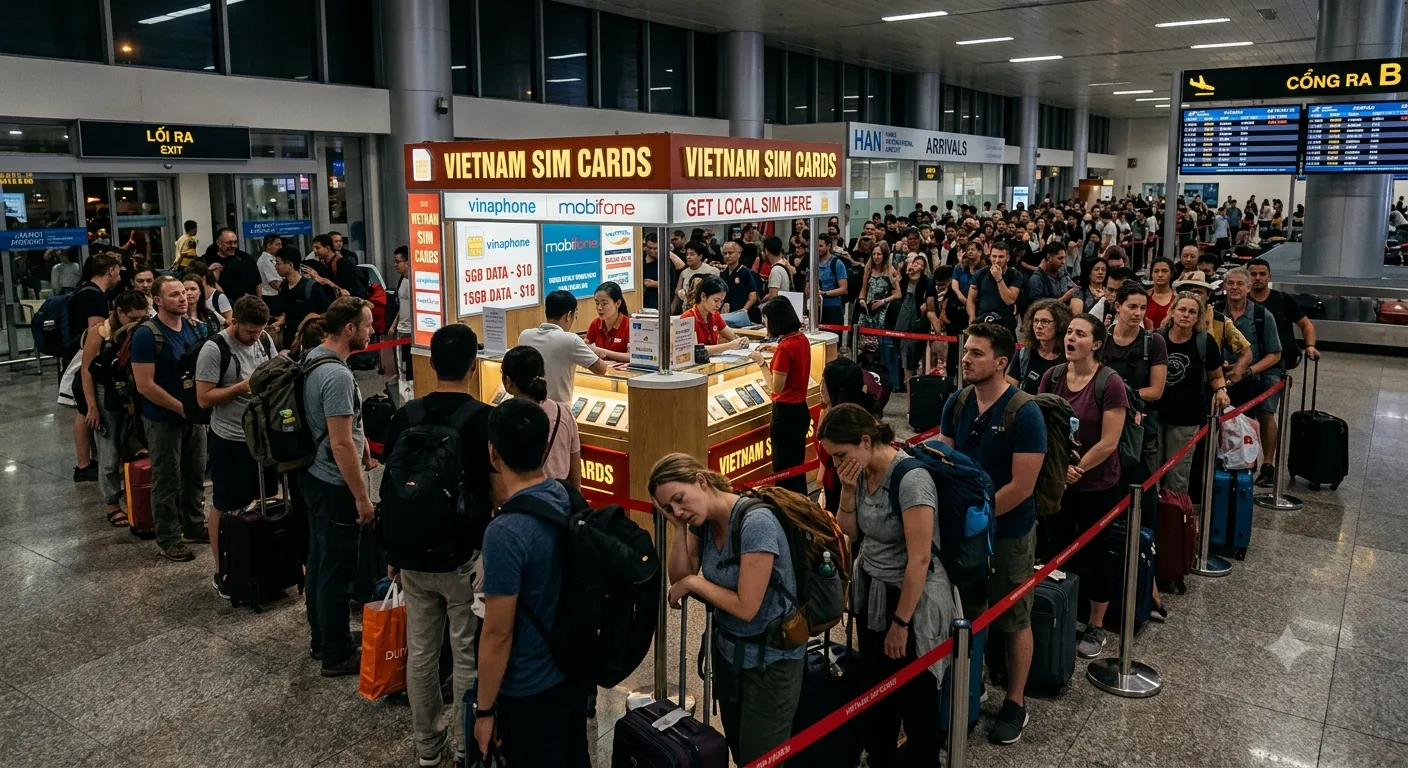
You can buy a SIM card on arrival, at the counters in Hanoi (Noi Bai) or Ho Chi Minh City (Tan Son Nhat) airports. Staff install and activate the card on the spot. But two downsides: prices there are often 30–100% higher than the same package in the city, and you have to queue after a long flight.
Above all, beware of “pre-activated” or “ghost” SIM cards sold without checking your passport: registered under a fake identity, they risk being blocked by the carrier without warning. We cover the scams and the right approach in our guide Vietnam airport SIM cards: prices, scams and the registration law.
The stress-free alternative: buy an eSIM online before you leave. You receive a QR code by email, install it calmly at home, and step off the plane already connected.
What the counter actually looks like. The same queue forms at Noi Bai and Tan Son Nhat every day: tired arrivals paying 200,000–400,000 VND (sometimes more) for a tourist package — typically 3–6GB/day, or a data pool spread over 7 to 30 days. The identical Viettel allowance costs closer to 60,000–180,000 VND for data alone in the city, or 150,000–300,000 VND for a full tourist bundle — so that markup is real, not imagined. It’s not really a scam; it’s rent, staffing and instant activation priced in. What the counter doesn’t advertise: buying a Viettel SIM or eSIM there means passport plus a live selfie for KYC, on the spot, right after a long-haul flight. Our Vietnam eSIM runs on a genuine local Viettel profile and skips both the queue and the counter KYC step — it activates automatically the moment your phone connects on arrival, no dialing codes or manual setup. Validity in Vietnam only starts on first connection, so there’s no cost to installing it early. Two minutes scanning a QR code from home gets maps, Grab and messaging working before you’ve even reached baggage claim.
Vietnam’s SIM registration law
Vietnamese law requires that every SIM card be registered to an individual. Under the current rules — Decree 163/2024, in force since 24 December 2024 — a foreigner registering a line must provide a valid passport (or qualifying electronic ID). When you buy at an official store or the airport, you’ll be asked for your passport and often a live photo for identity verification (eKYC) to register it in the national database.
Good news: an eSIM bought from a reputable provider is already correctly registered. You’re compliant without going through the counter, and you don’t risk a line being blocked in the middle of an excursion.
Installing and activating your eSIM
Installing an eSIM takes a few minutes and is done before you leave. On most recent phones (iPhone and Android alike), you simply scan a QR code, then turn on data roaming on arrival.
A local Viettel eSIM configures itself automatically with the official v-internet APN — no manual entry. If you hit an activation, APN or hotspot issue, our step-by-step guide covers every case: installing and activating your Vietnam eSIM on iPhone and Android.
Staying connected in remote regions
This is where the choice of network really matters. Two destinations regularly raise questions:
- The mountainous North — the Ha Giang loop by motorbike and Sapa. The deep valleys test every network, and Viettel keeps the edge. See: internet on the Ha Giang loop and in Sapa.
- Ha Long Bay and Phu Quoc island — between the karst towers and boat crossings, the signal fluctuates. We break it down here: wifi and connectivity in Ha Long Bay and Phu Quoc.
Continuing on to Laos?
Many travelers reach Laos via Vietnam — there are no direct flights from the West, so the classic route runs Hanoi → a northern crossing or a short hop → Luang Prabang. You don’t need a second SIM at the border: one regional Vietnam + Laos eSIM covers both countries on a single plan, so you step off the bus or plane in Laos already online — or pick up a standalone Laos eSIM once you cross. Planning the Laos leg? See our guide to getting from Hanoi to Vientiane.
Our Vietnam eSIM plans
SogdiaRoam sells a genuine local Viettel profile, not roaming. You connect directly to the country’s largest network, with a clear daily high-speed allowance and no vague fine print.
| Duration | Data | Price (USD) | Network |
|---|---|---|---|
| 7 days | 35GB total (5GB/day high-speed) | $9.90 | Local Viettel profile |
| 15 days | 75GB total (5GB/day high-speed) | $14.90 | Local Viettel profile |
| 30 days | 150GB total (5GB/day high-speed) | $19.90 | Local Viettel profile |
Visiting several Southeast Asian countries on the same trip? A regional eSIM can cover Vietnam and its neighbours — handy for a Thailand–Vietnam–Cambodia loop on one eSIM. For a price/data comparison against Holafly and Airalo, read our analysis of the best Viettel eSIM for Vietnam.
In summary
For a trip to Vietnam in 2026, remember three things: favour the Viettel network for coverage, plan for around 1GB per day (with margin if you stream), and buy a local eSIM before you leave to avoid counters, surcharges and ghost cards.
Ready to land connected? Choose your Vietnam eSIM at sogdiaroam.com, receive your QR code instantly, and step off the plane already online on the country’s largest network.
Frequently asked questions
Is an eSIM or a physical SIM card better for Vietnam? +
For most travelers, an eSIM is simpler: you install it before you fly and you're connected the moment you land — no airport kiosk, no passport hand-over. A physical SIM still makes sense if your phone isn't eSIM-compatible.
Which network should I choose in Vietnam? +
Viettel has the best nationwide coverage, especially in rural and mountainous areas (Sapa, Ha Giang, the Mekong Delta). Vinaphone and Mobifone are fine in cities but weaker in remote regions.
How much data do I need for a trip to Vietnam? +
Budget around 1GB per day for typical use (maps, messaging, social media). A 5GB/day plan comfortably covers browsing, occasional streaming and hotspot sharing.
Do I have to register my SIM card in Vietnam? +
Yes. Since 2016, every physical SIM must be registered with a passport. An eSIM bought online from a reputable provider is already correctly registered — you skip the counter entirely.
Get connected for your trip
Vietnam
Vietnam · 7 days · 35GB
35GB total (5GB/day)
- 5GB high-speed data per day
- Automatic activation
Automatic. Data works the moment the eSIM connects to Viettel. Nothing to dial, nothing to switch on.
QR emailed within minutes · Stripe secure checkout · No account needed
Vietnam
Vietnam · 15 days · 75GB
75GB total (5GB/day)
- 5GB high-speed data per day
- Automatic activation
Automatic. Data works the moment the eSIM connects to Viettel. Nothing to dial, nothing to switch on.
QR emailed within minutes · Stripe secure checkout · No account needed
Vietnam
Vietnam · 30 days · 150GB
150GB total (5GB/day)
- 5GB high-speed data per day
- Automatic activation
Automatic. Data works the moment the eSIM connects to Viettel. Nothing to dial, nothing to switch on.
QR emailed within minutes · Stripe secure checkout · No account needed